Tampilkan postingan dengan label China. Tampilkan semua postingan

Kamis, 24 November 2011

Shark fin goes off the menu at Peninsula hotels

The movewill affect the group's nine hotels, including those in China and Hong Kong,the center of the global shark fin market

guardian.co.uk,Justin McCurry in Osaka,  Thursday 24November 2011

73 million sharks are killed yearly for shark fin soup.
Photograph: Paul Hilton/EPA

Environmentalgroups are claiming a significant victory in the campaign to save the globalshark population, after the Peninsula hotel group said it would stop servingshark fin dishes from January.

Peninsula,one of Asia's most prestigious hotel chains, said on Monday it would no longersell the dishes, considered a delicacy in Hong Kong and other parts of theregion, "in recognition of the threat facing the global shark populationand in line with the company's sustainability vision".

The movewill affect the group's nine hotels, including those in China and Hong Kong,the center of the global shark fin market.

Hong Konghandles between 50% and 80% of the global trade in shark fins, bringing incatches from more than 100 countries, with Spain its biggest supplier. In 2006it took delivery of more than 10,000 tonnes worth US$276m, according to the UNfood and agricultural organisation.

Most isconsumed in Hong Kong and Taiwan, but also in mainland provinces such asGuangdong, where its consumption has become a status symbol among China'snouveau riche.

Hong Kongand Shanghai Hotels, which owns the Peninsula group, said it would honourrequests for shark fin soup made before 21 November, for consumption after 1January.

The dish,which comprises pieces of rehydrated shark fin in a rich broth, is a popularstaple at wedding parties and formal banquets, with a serving for 12 people costingaround US$138.

In HongKong districts such as Sheung Wan, which specialises in dried seafood, premiumshark fin can fetch up to US$1,280 per kilo. One Sheung Wan wholesaler recentlytold the Guardian, however, that the market price had dropped by about 20% inthe past two months, partly as a result of the campaign.

About 73million sharks are killed every year, and the appetite for their fins in placessuch as Hong Kong has taken one in three shark species to the brink of extinction.

"Byremoving shark fin from our menus, we hope that our decision can contribute topreserving the marine ecosystem for the world's future generations," thePeninsula group's chief executive, Clement Kwok, said in a statement.

"AsAsia's oldest hotel company, we also hope that our decision will inspire otherhospitality companies to do the same."

Otherluxury hotel chains have attempted to reduce shark fin consumption by offeringalternative menus for wedding banquets, sometimes with inducements such as a freenight's accommodation for the newlyweds.

The push toremove the delicacy – prized more for its glutinous texture than for its taste– has gathered momentum after a slow start, according to World Wildlife Fund,which has seen 97 caterers and hotels sign up to its alternative shark-freemenu in the past year.

A 2010survey of eating habits by Bloom Association, a marine conservation group,found that despite the dish's central place in Cantonese cuisine, attitudeswere shifting, particularly among younger people.

Accordingto Bloom, 66% of Hong Kong diners said they were uncomfortable with the idea ofeating an endangered species, and more than three-quarters said they would notmind if it was removed from banquet menus.

ThePeninsula announcement came as the European commission called for a global ban on shark finning – the practice of cutting off a shark's fin and throwing itsbody back into the sea – by EU fishermen. EU countries are responsible forabout 14% – the second-largest share – of the global shark catch.


Jumat, 18 November 2011

Fishermen Sue ConocoPhillips Over China Oil Spill

Jakarta Globe, November 18, 2011

Relatedarticles

Beijing. Agroup of Chinese fishermen is suing ConocoPhillips for damages allegedly causedby a huge oil spill at an offshore field operated by the US energy giant, theirlawyer said on Friday.

Theearly-June spill leaked more than 3,000 barrels of oil and oil-based mud — asubstance used as a lubricant in drilling — off China’s eastern coast, drawingwidespread public criticism and warnings from Chinese authorities.

The grouphas filed a civil lawsuit in a court in the eastern city of Qingdao asking the Houston-basedfirm to pay 30 million yuan ($4.7 million) to more than 200 fishermen livingthere, Yi Jiafeng told AFP.

“Inenvironmental pollution lawsuits, we follow the principle of ‘inverseresponsibility of providing proof’ — the victims detail the damage and therespondent must provide counter evidence,” he said.

ConocoPhillipswas not immediately available for comment.

Environmentalgroups and local fishermen have accused the US firm and its Chinese state-runpartner CNOOC of initially covering up the spill, which was discovered in Junebut only made public nearly a month later.

But bothfirms deny the allegations. ConocoPhillips says it cooperated with authoritiesas soon as the accident occurred in Bohai Bay in northeast China.

“Anyrelease of oil, no matter the size, is too great,” it said in a statement onits Web site.

CNOOC,meanwhile, said last month all the leaks had now been identified and sealed,the official Xinhua news agency reported.

Thefishermen involved in the lawsuit claim they lost a total of 164,000 yuaninvested in clam seedlings and 17,000 undersea cages — only 3,000 of which hadclams left alive after the spill, the official Beijing News reported.

The StateOceanic Administration — the government agency that supervises and managesChina’s seas — has also said it will sue ConocoPhillips over the leak.

But anearlier civil lawsuit connected to the spill was dismissed by a court in thenorthern port of Tianjin for lack of evidence, the Beijing News said.

Yi, whofiled the lawsuit Friday, said it would take seven days for the Qingdao courtto decide whether or not it would accept the case.

Agence France-Presse
Related Article:


Kamis, 10 November 2011

Shark fin soup disappearing from the menu at Chinese weddings

Couplesmarrying in Hong Kong and mainland China swayed by conservation groups'campaign to ban shark trade

guardian.co.uk,Justin McCurry in Hong Kong,  Thursday 10November 2011

A fisheries worker carries shark heads in Zhejiang province in China.
 Shark fin soup has long been considered a delicacy by Chinese people,
but that could be changing. Photograph: Chinafotopress/Getty Images

Chinesecouples who have chosen Friday – 11/11/11 – one of the most auspicious days ofthe year to exchange their wedding vows, could be among the last to mark theoccasion by feasting on shark fin soup, if environmental groups get their way.

As thewedding parties scoop pieces of the slippery, glutinous flesh from bowls ofbroth, they will not just be respecting tradition; they will also be defying agrowing campaign to ban the trade in shark fin that has now spread to its mostlucrative market, Hong Kong.

It is easyto see during a short walk through Sheung Wan, a Hong Kong neighbourhoodspecialising in dried seafood, why the campaign to ban the trade worldwide hasset its sights on the city.

Shark finsfill shop windows, ready to be hydrated and boiled before being added to a richbroth, a gastronomic preserve of wealthy Chinese since the Song Dynasty in the10th century.

Risingprosperity since the 1970s has made the delicacy affordable to the middleclasses, first in Hong Kong and now on the mainland. Eating it is so closelyassociated with new wealth that to say someone is "eating shark fin withrice" is to refer to their prosperity.

Hong Konghandles as much as 80% of the global trade in shark fins, bringing in catchesfrom more than 100 countries, with Spain by far its biggest supplier.

In 2006 ittook delivery of more than 10,000 tonnes worth $276m (£173m), according to theUN food and agricultural organisation. Most is consumed in Hong Kong andTaiwan, but also in mainland provinces such as Guangdong.

Campaignerssay it is next to impossible to verify the fins' provenance, as they are driedand bleached, and often treated with ammonia, before reaching Hong Kong.

"Thecatches are not tracked at all, and there is no species monitoring orlabelling," says Stanley Shea, a campaigner with the marine environment group Bloom Association, which last year conducted the most comprehensivesurvey to date of shark fin consumption in Hong Kong.

"Wedon't even know how much of it is eaten here or ends up in mainlandChina."

Many shark populations have plummeted by 90% in recent decades, according to campaigners,who warn that if over-fishing continues at the current rate, the most commonlytargeted species will be extinct in a few years.

DNAanalysis showed that 40% of shark fin auctioned in Hong Kong comes from 14species, all of which appear on the International Union for the Conservation ofNature's "red list" of endangered species.

After yearsof fierce opposition from traders and retailers, campaigners in Hong Kong saythe local population is finally waking up to the ecological catastrophe.

Severalhotels offer discounts, cheaper room rates and other incentives for couplesthat choose not to serve shark fin at their wedding celebrations.

One onlinecampaign calls on wedding guests to reduce cash gifts by about a third forcouples who select the dish.

Last yearcampaigners persuaded Citibank Hong Kong to withdraw a promotion offering newcredit card holders discount on a shark fin dinner.

On themainland Yao Ming, the Chinese NBA star, has appeared in a well-receivedcampaign to end finning, the practice of removing a shark's highly valued finsand dumping what is left into the sea.

But thereare pockets of resistance, particularly among older people, who still regardeating shark fin as a means of expressing their Chinese identity.

"Atweddings you have different people sitting around the same table," saysShea. "Young people understand the problem and want to do something aboutit, but at some point their parents stop them."

The managerof one Sheung Wan wholesaler, who asked not to be named, said traders werebeginning to feel the impact of the environmental campaign.

"Salesare dropping and I think that is down to the campaign," he said. Themanager's firm sells between three and four tonnes of shark fin a month.

"Thewholesale price has dropped by about 20% over the past two months, althoughthere are always fluctuations so it's too early to tell if this is a lastingtrend."

CharlieLim, a shark fin trader, is receptive to the message on sustainable fishing butaccuses some campaigners of hypocrisy.

"TheChinese tradition of eating shark fin will be maintained, but will increasinglycome from sustainable fisheries," says Lim, a prominent member of HongKong's marine products association.

"Chinesepeople and traditions do make an easy and readily identifiable target forlargely western campaigners.

"Butmany western campaigners who are seriously interested in promoting thesustainable use of sharks should look more closely at their home fisheries andthe 'boneless' fish products that their children may be eating from thesupermarket."

Despite itsearly successes, the campaign has yet to challenge shark fin's place at theheart of Cantonese cuisine.

Bloom's2010 survey revealed that 89% of the territory's 7 million people had eaten thedish at least once in the past year, with more than half saying they did so toobserve tradition. Another poll found that only 5% of couples had opted forshark-free wedding banquets.

But 66%said they were uncomfortable with the idea of eating an endangered species, andmore than three-quarters said they would not mind if it was removed frombanquet menus.

Sheabelieves Hong Kong will be viewed as a pariah as long as it fails to introducemeasures to protect shark populations similar to those introduced elsewhere.

"HongKong has always been a role model for the rest of China, and this issue shouldbe no different," he says.

"Ourmessage is that eating shark fin is unsustainable. At some point, the market isgoing to crash."

Sabtu, 20 Agustus 2011

ConocoPhillips admits discovery of nine new oil spill sources

English.news.cn   2011-08-21

BEIJING,Aug. 20 (Xinhua) -- ConocoPhillips China, a subsidiary of the U.S-based oilcompany ConocoPhillips, admitted Saturday that nine new oil spill sources havebeen found from its Penglai 19-3 oilfield Platform C.

The companyreported to the North China Sea branch of the State Oceanic Administration(SOA) that it has discovered nine new oil spill sources from the areas within15 meters north of the Platform C in China's Bohai Bay.

The SOA hasasked the company to make a thorough investigation of the cause of oil spillsto prevent similar cases.

The oilgiant on Friday extended an apology for conduct that led to oil leaks in theBohai Bay, pledging to accelerate its clean-up efforts and take measures toensure that similar accidents will not happen in the future.

The companyreported to authorities two oil spills in its Penglai 19-3oilfield in June. Itadmitted another two oil leaks earlier this month, with one from Platform C andthe other from Platform B.

Editor: Mu Xuequan
Related Article:

Rabu, 22 Juni 2011

China to boost offshore wind power to 30 gigawatts by 2020

People's Daily Online, by Ye Xin, China, June 22, 2011

In the next five years, China will boost its offshore wind power installed capacity to 5 gigawatts and form a complete technology and industrial chain. Afterward, China's offshore wind power will enter into a phase of large-scale development and is estimated to reach 30 gigawatts in 2020, according to the energy plan and renewable energy plan during the 12th Five-Year Plan.

The National Energy Bureau (NEB) will launch preparation work for the second public bidding on offshore wind power concession projects in the second half year of 2011 and is scheduled to complete the bidding in the first half year of 2012. The total construction scale will be between 1.5 gigawatts and 2 gigawatts, according to news from a symposium on offshore wind power held in Nantong City of east China's Jiangsu Province on June 22.

Offshore wind power is the frontier of the development of global wind power. China's enterprises must reach the international advanced level in offshore wind power, said Liu Qi, deputy director of the NEB.

In June 2010, the first stage project of East Sea Bridge Offshore Wind Farm went into operation in Shanghai. Totaling 102 megawatts, it is China's first large-scale offshore wind farm and is located on the east side of the Shanghai East Sea Bridge. It comprises 34 units of 3-megawatt Sinovel turbines.

In addition, China Longyuan Electic Power Group Corp. built the world's first experimental offshore wind farm in 2010 and the follow-up project started on June 21, 2011.


Related Article:

Kamis, 19 Mei 2011

China sets up first 7 national ocean parks

English.news.cn   2011-05-19

BEIJING, May 19 (Xinhua) -- China's State Oceanic Administration (SOA) announced Thursday that the country has named its first seven national ocean parks to ensure sound ecological environment and sustainable development for coastal tourism.

The seven parks are sprawled along China's coastal areas, with two in Guangdong, two in Shandong, and one in Guangxi, Fujian and Jiangsu, respectively, SOA spokesman Li Haiqing said at a press conference.

According to the SOA, the largest park covers an area of 51,455 hectares and is located in Lianyungang, Jiangsu Province.

The SOA also announced the expansion and improvement of five national special marine reserves in eastern Shandong Province.

Chen Liqun, an official with the SOA's environmental protection and management bureau, said the parks and reserves will coordinate oceanic ecological protection with the use of oceanic resources.

"The national ocean parks, which provide beautiful beach resorts for the public, can promote marine eco-environment protection and facilitate sustainable development of coastal tourism," Chen explained.

China established its first national special marine reserve in 2005. With the newly-announced projects, it now has 21 national special marine reserves and seven national ocean parks, covering a total area of nearly 360,000 hectares, SOA figures show.

In addition, the country also has 33 national marine nature reserves.

In contrast to marine nature reserves, which ban or restrict exploitation, special marine reserves and ocean parks are permitted to be developed in a scientific way under the principles of scientific planning, unified management, and a protection-first philosophy with appropriate utilization.

Editor: An

Selasa, 03 Mei 2011

55 Feet Long Unknown Fish Species Found in China


According to a local newspaper, the big fish weighs at least 10,000 pounds.

A 55 feet long fish has been found in the seashore of Guangdong, China.

Hwang, a 66-years-old fisherman living in the near area, said he has never seen anything like this in his whole life and that the fish was tied with ropes when it was first found.

Many people have flocked to see this strange specimen since its discovery, although its rotting corpse already emits a foul smell.

The people living in the area think the fish was caught by some fisherman but was abandoned due to its heavy weight, hence the ropes.

Due to the serious decay of the fish's body, it is almost impossible to identify the species, according to the local newspaper.

The fish was discovered on April 25th.

Minggu, 17 April 2011

Chinese white dolphins -- "giant panda in the sea"

English.news.cn   2011-04-17

Two Chinese white dolphins play in the Sanniang Bay of Qinzhou city,
southwest China's Guangxi Zhuang Autonomous Region, April 16, 2011.
Sanniang Bay scenic zone is one of the habitats of the Chinese white dolphins,
 which is under the state first-grade protection and known as the "giant panda
 in the sea". In recent years, the Chinese white dolphins in Sanniang Bay have
attracted numerous tourists from home and abroad. 
(Xinhua/Zeng Kaihong)

Tourists watch the Chinese white dolphins on a boat in the Sanniang Bay
 of Qinzhou city, southwest China's Guangxi Zhuang Autonomous Region,
 April 16, 2011. Sanniang Bay scenic zone is one of the habitats of the
 Chinese white dolphins, which is under the state first-grade protection
and known as the "giant panda in the sea". In recent years, the Chinese
 white dolphins in Sanniang Bay have attracted numerous tourists from home
and abroad.
(Xinhua/Zeng Kaihong)

Senin, 27 Desember 2010

Three Chinese Naval ships making goodwill visit

Antara News, Monday, December 27, 2010

Jakarta (ANTARA News) - Three Chinese Navy ships arrived at Indonesia`s Tanjung Priok port on Monday n a goodwill mission during which their crews would execute several programs designed to improve bilateral relations between the two countries.

The flotilla`s commander, Major General Wei Xueyi, said in his remarks on arrival that the visit was intended to enhance relations between the two navies and the two countries in general.

The Chinese ships were welcomed by Chinese Ambassador to Indonesia Zhang Qiyue and Brigadier General Arif Suherman, commander of Indonesia`s third navy base (Lantamal III) and members of the Chinese community in Indonesia.

"During our visit, our crews will also take the opportunity to go sightseeing in the Indonesian capital, meet local people, and sample local life. We are very pleased to have this chance of visiting Indonesia," Major General Wei Xueyi said

Chinese Ambassador Zhang Qiyue said the Chinese warships` visit was part of activities to mark 60 years of Indonesia-China diplomatic relations and friendship this year. The visit was also expected to improve the relationship between the navies of the two countries.

During their five-day stay in Indonesia, the Chinese crews are to conduct a series of activities, including visiting Indonesian naval ships , and compete with Indonesian naval personnel in several sports events.

"I hope the visit will improve our communication and understanding with the Indonesian navy as well as the Indonesian people. We also hope the friendship between Indonesia and China will develop further in the future ," he said.

The Chinese flotilla consists of an amphibious landing ship, the Kunlunshan, a destroyer, the Lanzhou, and a supply ship, the Weishanshu and carrying a combined crew of 1,000 men.

It had just completed patrol duties in the Gulf of Aden and in Somali waters to combat sea piracy rampant in those areas.

The flotilla is the sixth China had deployed in the Gulf of Aden and in Somali waters.

The previous five Chinese flotillas in the Gulf of Aden had escorted 2,248 Chinese and foreign ships in 213 batches in this region, which have been plagued by pirate attacks, since December 2008.

The sixth flotilla had escorted 615 ships, including five from Indonesia, during its service period, expelling 190 suspicious boats, saving one ship hijacked by Somali pirates and three others being chased by pirates.

Sabtu, 18 Desember 2010

China fishing boat capsizes in scuffle

The Jakarta Post, The Associated Press, Seoul | Sat, 12/18/2010

Sinking boat: A Chinese fishing boat is seen capsized in western South Korean waters off Gunsan, South Korea, Saturday. The fishing boat capsized in a maritime scuffle with a South Korean coast guard ship trying to curb its illegal fishing activities Saturday, killing one fisherman and leaving two others missing, a South Korean official said.

A Chinese fishing boat capsized in a maritime scuffle with a South Korean coast guard ship trying to curb its illegal fishing activities Saturday, killing one fisherman and leaving two others missing, a South Korean official said.

About 50 Chinese fishing boats were illegally fishing in western South Korean waters off Gunsan city, about 170 miles (270 kilometers) south of Seoul, when the South Korean ship approached them, coast guard spokesman Ji Kwan-tae said. One of the boats intentionally hit the larger coast guard ship to allow fellow Chinese vessels to sail back to their waters, and then capsized, he said.

Eight people from the capsized boat were plucked from the waters, but one was unconscious and later died, Ji said. Coast guard rescue boats and helicopters were dispatched to the area to locate the two missing Chinese sailors, he said.

Ji said coast guard officers fought with fishermen on other Chinese boats who wielded steel pipes, and four of the officers suffered non-life-threatening injuries.

A man answering the phone at the China Maritime Search and Rescue Center in Beijing confirmed that a Chinese fishing boat capsized Saturday in the Yellow Sea and two Chinese fishermen were missing. China has dispatched a rescue boat and has asked South Korea to send boats as well, he said.

When asked about South Korea's claim that the Chinese boat was fishing illegally, the man said other information about the incident was still being collected. He did not give his name, as is common with Chinese officials.

Calls to the Chinese Embassy in Seoul went unanswered.

More than 300 Chinese fishing boats are captured for fishing illegally in South Korean waters every year, according to South Korea's coast guard. In 2008, one South Korean coast guard officer was killed and six others injured in a maritime scuffle with Chinese fishermen engaged in unauthorized fishing in South Korean waters.


Related Articles:

Jumat, 05 November 2010

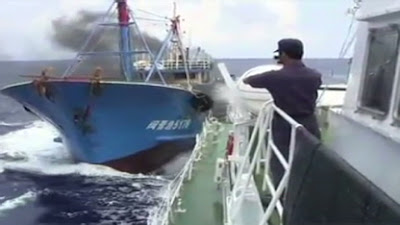
Lawmaker: Leaked video shows crash that led to China-Japan dispute

CNN News, From Kyung Lah, November 5, 2010

Japan, China ship collision fuel tensions

STORY HIGHLIGHTS
  • The YouTube video is authentic and not doctored, a Japanese legislator says
  • He calls the leak "a big mistake for the government"
  • China has made an "official inquiry" with the Japanese prime minister's office
  • Kan's office is investigating the leaking of the video

Tokyo, Japan (CNN) -- A leaked video is circulating in cyberspace, showing a boat collision that sparked a recent diplomatic battle between China and Japan.

The YouTube video shows the same collision that Japanese lawmakers watched on video last week, said legislator Hiroshi Kawauchi, of the ruling Democratic Party of Japan.

The Japanese Coast Guard shot the video, which is authentic and not doctored, said Kawauchi, who is a member of the House of Representatives in the Diet, Japan's legislature.

"The fact that the video was leaked is a big mistake for the government," he added. "It is totally different from presenting it to the public in an official manner, and it leads the people's further erosion of faith in Japan's government."

In September, Japan detained the crew of a Chinese fishing boat off disputed islands in the East China Sea. China calls the islands the Diaoyu; Japan calls them the Senkaku.

In response to the detainments, China made increasingly aggressive diplomatic threats. Beijing also halted ministerial-level talks with Tokyo, and both sides canceled trips to each other's nations.

Japan has since released the fishing crew, who China says were stopped illegally. Japan initially accused the captain of obstructing Japanese public officers while they performed duties. But authorities later said that releasing him was in the interest of maintaining relations with China.

The crash video that Japanese lawmakers saw has not been released to the public.

The video, posted on YouTube, shows what is thought to be the Chinese fishing trawler ramming into a ship, thought to be a Japanese Coast Guard vessel.

The Chinese government dismissed the video after Japanese lawmakers saw it, saying it had been edited and that it did not change the ownership of the islands.

On Friday, China's Assistant Minister of Foreign Affairs Cui Tiankai said: "I think the China-Japanese relationship has to overcome the current difficulties and move forward. This will serve the fundamental interests of both countries. So [we] hope [the] Japanese side will do everything possible to make sure that there's no further disruptions of the relationship."

The Chinese Embassy in Tokyo has contacted the office of Japanese Prime Minister Naoto Kan about the leaked video, making an "official inquiry," Kan's office said. No official protest was lodged.

Kan's office is investigating the leaking of the video, which has been shown on Japanese television.

The man apparently doing the videotaping says on the video that the date is September 7, 2010. That matches the detaining of the fishing crew.

The man also says on the video, in Japanese: "We've ordered them to stop, in Chinese language, but they didn't stop."

As the Chinese boat approaches, shouting is heard in Japanese. Unidentified voices shout: "Back off! Back off!"

CNN's Jo Ling Kent contributed to this report.


Related Articles:

Rabu, 08 September 2010

34 rescued from China oil platform accident

Yahoo/AP, Tue Sep 7, 11:13 pm ET

BEIJING – Emergency teams with helicopters rescued 34 workers Wednesday from an oil drilling platform that was leaning dangerously in the East China Sea after a storm, and searched for two others still missing, officials said.

The No. 3 drilling platform in the Shengli oil field, operated by Sinopec, Asia's largest refiner by capacity, started tilting over Tuesday, causing four workers to fall into the water and trapping 32 of them on the platform, the Transport Ministry said in a statement on its website.

Rescue helicopters were dispatched to the site from the coastal city of Dalian at around 6 a.m. local time, the ministry said.

The platform was tilting at a 45 degree angle to the sea, around five nautical miles (nine kilometers) from the coast, where the water is 23 feet (seven meters) deep, the official Xinhua News Agency said.

A typhoon caused the platform to tilt, said a man surnamed Sun from the Shengli Oil Management Bureau of Sinopec, also known as China Petroleum & Chemical Corp., in Dongying in Shandong province.

Sun said winds were blowing at up to 55 miles per hour (24.4 meters per second), causing 13-foot (four-meter) waves.

Rabu, 05 Mei 2010

Thousands of Ming artifacts secured from shipwreck in Java Sea

Erwida Maulia, The Jakarta Post, Subang, West Java | Wed, 05/05/2010 10:18 PM

Over 12,400 items of Chinese ceramics believed to originate from the Ming dynasty era have been secured from a ship wreck in Belanakan waters in Subang, West Java.

The ceramics have been gathered during the past month of diving operation around and into the wreck of 50 m x 20 m ship that lies 58 meters under the surface of Java Sea.

White ceramic plates, bowls and vases with blue motives, mostly floral, construct most found items; 40 percent of which are still in good condition.

"It is predicted to be a cargo ship sunken somewhere in 1,600s... Archaeologists believe, from the blue motives of the white ceramics, that they originate from the Ming dynasty," Maritime Affairs and Fisheries Ministry's director general for surveillance and control, Aji Sularso, said aboard a patrol ship on Wednesday after surveying the lifting of the ceramics 48 miles off the coast of Belanakan.

"Given the large size of the cargo, we predict that we need to dive for a year to secure all of its precious loads, which may amount to 1 million pieces; larger than the number of items secured from the shipwreck in Cirebon."

Aji said he expected to find gold bars among the loads so as to cover the survey and lifting costs of the artifacts, predicted to exceed US$10 million, the total costs needed to secure loads of the Cirebon shipwreck offered in a bid also on Wednesday in Jakarta.

The presence of the shipwreck along with its loads in Belanakan waters was confirmed in a survey conducted between July and October last year, following some local fishermen's finding of ceramics in their fish nets.

The lifting of the artifacts, Aji said, began in early April, with 22 professional divers specially hired to secure the precious loads from the shipwreck and brought them to the surface.

The Indonesian government, through the national committee for shipwreck loads, is partnering with local private firm PT Comexindo to conduct the survey, as well as to secure and store the precious loads.

Related Article:

Java Sea shipwreck yields Ming bounty


Kamis, 22 April 2010

Indonesia’s Seaweed Export Value to China up by 400 Percent

Tempo Interactive, Thursday, 22 April, 2010 | 16:05 WIB

TEMPO Interactive, Makassar: China has become South Sulawesi’s biggest seaweed market. This can be seen from the export value that skyrocketed from US$ 2,574 million in 2008 to US$ 10,603 million 2009, a 400 percent increase.

“The reason is simple; China has just imported seaweed directly from us,” said Arman Arfah, chairman of South Sulawesi Farmer and Seaweed Processor Association, yesterday.

Earlier, Indonesia’s main destination for seaweed exports was the Philippines. Then, China imported the commodity from the Philippines. However, since the Indonesian Seaweed Forum was held in Makassar in 2008, Indonesia began exporting directly to China.

The international forum is held every three years. The next assembly will take place in 2011.

In general, the export value of Indonesia’s seaweed from 2008 to 2009 increased by five percent. The total export value in 2009 amounted to US$ 17,619 million.

Indonesia is ranked fourth in the world’s seaweed exporter list. Indonesia’s major seaweed market is China, the Philippines, South Korea, Chile, and Vietnam.

The government continues to intensify programs improving seaweed production. At present, the country produces two million tons of wet seaweed per year. Meanwhile the Maritime and Fishery Ministry’s target for 2014 is 10 million tons per year.

The government is also making efforts to improve and set a standard quality. The world’s demand in wet seaweed is six million tons per year.

To avoid excessive production if the government’s target is achieved, the South Sulawesi Farmer and Seaweed Processor Association is implementing a program promoting the consumption of seaweed and healthy fibrous foods.

“Seaweed is healthy, so we should not export all of it,” Arman said.

FADHILAH NAZIF

Selasa, 06 April 2010

Treasure from shipwreck awaits auctioning

The Jakarta Post, Tue, 04/06/2010 11:59 AM

CIREBON: Thousands of artifacts pulled from a shipwreck dating back to the 10th century in waters north of Cirebon, West Java, will be auctioned off next month by a government team.

The auction will be held in Jakarta on May 5, the National Committee of Excavation and Utilization of Precious Artifacts from Sunken Ships (Pannas BMKT) said in a press release Monday.

"The findings of Cirebon's Pannas BMKT operation comprise 271,000 items, making it one of the biggest findings in the country's history. Among the artifacts are China ceramics from the 10th century *Yue Mise Dynasty*, glass and rock crystals from the Middle East and Africa and other precious items, like gold coins and jewelry, silver jewelry and precious stones," the statement said.

The government-licensed project was conducted by PT Paradigma Putra Sejahtera in cooperation with Cosmix Underwater Research Ltd.

Pannas BMKT has published a book titled Kapal Karam Abad ke-10 (Sunken Ship of the 10th Century) about the recovery effort and the artifacts. The government has named a number of artifacts from the wreck as historical artifacts and has claimed them as state assets. - JP

Minggu, 04 April 2010

Australia alert over oil leak on Great Barrier Reef


There are concerns the Shen Neng I may break up

A Chinese ship has run aground off north-eastern Australia, sparking an alert of an oil leak into the Great Barrier Reef.

The Shen Neng I, carrying 950 tonnes of oil, ran aground 70km (43 miles) off the east coast of Great Keppel Island.

Oil patches have been seen and officials said there were real concerns the ship may break apart, causing a greater spillage.

Conservationists say they fear for a major accident in the future.

The Shen Neng I, with a crew of 23, was carrying about 65,000 tonnes of coal to China from the Australian port of Gladstone.

Queensland Premier Anna Bligh said the ship was in danger of breaking up.

"We are now very worried we might see further oil discharged from this ship," she said.

Maritime Safety Queensland general manager Patrick Quirk said: "It is in danger of actually breaking a number of its main structures and breaking into a number of parts."

Capricorn Conservation Council spokesman Ian Herbert told the Australian Associated Press he feared the latest incident was "a sign of things to come".

"We are outraged that no marine pilot is required on ships between Gladstone and Cairns," he said.

The Great Barrier Reef is the world's largest reef system and extends for more than 2,500km.

(Photo: Daily Mail)


Related Articles:

Australia arrests crew of China Barrier Reef ship

Cargo ship crew charged over Great Barrier Reef route

Stranded ship "time bomb" to Great Barrier Reef

Oil spill clean-up underway

Race against time to stop oil leak on Great Barrier Reef after Chinese coal ship runs aground


Related Posts Plugin for WordPress, Blogger...