Tampilkan postingan dengan label Tsunami. Tampilkan semua postingan

Rabu, 30 Maret 2011

Japan fears radioactive contamination of marine life

Fukushima coastal waters sees high levels of radioactive iodine, which could build up in seaweed commonly eaten in Japan

guardian.co.uk, Ian Sample , science correspondent, Wednesday 30 March 2011

Radioactivity fears deliver a double whammy to Japanese fisheries which
have already been badly hit by the tsunami. Photograph: Everett Kennedy Brown/EPA

High levels of radiation in the sea off the coast of Fukushima have raised concerns over harm to local marine life and the risk of contaminated fish, shellfish and seaweed entering the food chain.

Tests on seawater near the nuclear power plant showed that levels of radioactive iodine reached 3,355 times the legal limit on Monday, one of several peaks in recent days that have fallen rapidly as radioactive substances decayed and were steadily diluted and dispersed by ocean currents.

Officials are watching levels of iodine-131 in seawater because although it has a half-life of eight days, meaning it is half as radioactive after that time, the substance builds up in seaweed, a common food in the Japanese diet. If consumed, radioactive iodine collects in the thyroid and can cause cancer.

The International Atomic Energy Agency said iodine-131 in seawater would "soon be of no concern" presuming there are no further discharges of contaminated water from the power station into the sea.

The IAEA added that Japanese authorities have released the first analyses of fish, caught at the port of Choshi, in Chiba prefecture south of Fukushima, which found one of five to be contaminated with a detectable level of caesium-137, a far more persistent radioactive substance, though at a concentration that was far below safety limits for consumption.

Many countries, including Britain, have begun radiation testing of fish, shellfish and other fresh produce from Japan or have imposed wider bans on imports from the region. Fisheries are not entering waters within the 20km (12-mile) exclusion zone around Fukushima, said Hidehiko Nishiyama, a spokesman for Japan's Nuclear and Industrial Safety Agency.

The fate of many local seafood and shellfish farms, including scallops, oysters, sea urchins and sea snails, was sealed more than two weeks ago when the tsunami wiped out beds and destroyed fishing vessels and ports around Fukushima. In Iwate prefecture, authorities say the disaster may have wiped out businesses that account for 80% of the revenue of the region's fisheries.

At the Fukushima power plant, engineers continued the arduous task of trying to pump contaminated water from turbine rooms and trenches, which is hampering work to connect the reactor cooling systems to the national grid.

Tepco, the power station operator, plans to spray parts of the site with a resin to stop radioactive dust blowing off the site and is considering shrouding the reactor buildings with sheets to reduce radiation being released into the air.

Fish and other sea creatures are unlikely to be seriously harmed by the radioactive leaks, even in the most contaminated areas. After the Chernobyl nuclear disaster, fish in three freshwater lakes within the exclusion zone became contaminated with radioactive caesium but showed no obvious health problems, though some fish were born with reproductive abnormalities which may have been caused by radiation, said James Smith, an environmental physicist at Portsmouth University who studied fish in the area.

While fish accumulate radioactive contamination, this happens less in the ion-rich waters of the oceans than in freshwater lakes.


Related Articles:

Sabtu, 26 Maret 2011

Radiation in seawater off nuclear plant spikes to 1,250 times normal

CNN News, By the CNN Wire Staff, March 26, 2011


Workers in protective suits prepare Thursday to decontaminate two
nuclear plant workers in Fukushima, Japan.

STORY HIGHLIGHTS
  • The previous day, levels were only 104 times above normal
  • A Tokyo Electric official says it's not known what caused the spike
  • Radiation in seawater near nuclear plant tests 1,250 times above normal
  • Radiations levels in tap water in Ibaraki prefecture now considered safe

Tokyo (CNN) -- Tests showed a sharp spike in levels of radioactive iodine in seawater just offshore of the embattled Fukushima Daiichi nuclear plant are more than 1,250 times higher than normal, Japan's nuclear and industrial safety agency said Saturday.

In samples taken Friday morning from a monitoring station 330 meters off the coast, the levels were 50 becquerels of radioactive iodine per cubic centimeters of water. This compares to 4 becquerels -- which is 104 times above normal -- in samples taken from the same spot the previous morning.

These high levels suggest there may have been some sort of leakage directly into the ocean -- unlikely to be because of atmosphere emissions or rain alone, said an official with the Tokyo Electric Power Co., which operates the nuclear plant.

A Tokyo Electric official told CNN that authorities are not sure why the levels spiked. The official speculated that the radioactive iodine may have been swept off the coast recently into the Pacific Ocean or the tainted water may have seeped from turbine buildings for two nuclear reactors that have shown the presence of radiation 10,000 times the normal amount.

Still, an official with Japan's nuclear safety agency told reporters Saturday that -- while drinking such tainted seawater would be dangerous, given the radiation's potential to cause cancer -- the effect on aquatic life imay be relatively minimal.

That's because the radiation tends to dilute, the farther one moves away from the nuclear plant. Data posted on the Japan's education and science ministry website showed relatively small amounts of radioactive particles several kilometers offshore.

The International Atomic Agency reported online Saturday that radioactive iodine and cesium was detected 30 kilometers (19 miles) offshore, but it said that these levels differed only slightly from the previous day.

That said, its potential effect on Japan's fishing industry -- even if consumers stay away, for simple fear of contamination -- remains a major concern. So, too, is the fact that authorities have yet to pinpoint the exact source of the radiation, and thus to determine if it's stopped.

The latest data, from Friday, posted online by Japan's education, science and technology ministry show continuing evidence of airborne radiation in prefectures around the nation. Still, in no cases is the exposure considered harmful to human health -- and, in fact, in many cases, radiation readings have gone down.

In the Fukushima prefecture where the plant is located, officials had screened 87,813 people for radiation exposure as of Thursday, Japan's nuclear safety agency said a day later in a news release.

Of those 98 people had tested above limits for exposure, but once their clothes were removed and other measures taken, the exposure levels dropped and there was no effect on health.

The agency also said screeners have examined thyroid glands of 66 children ranging in age from 1 to 15 and found that the "level of exposure of no problem."

The thyroid gland, particularly in children, can readily absorb radiation, health experts say.

Meanwhile, authorities continue to monitor radiation levels in tap water around Japan.

RELATED TOPICS

Information from Japan's education, science and technology ministry indicate the presence of radioactive iodine in the tap water of 12 prefectures. This does not include Fukushima and Miyagi, where measurements aren't being taken because of damage from the March 11 earthquake and subsequent tsunami.

The government of Ibaraki prefecture reported Saturday that radiation levels had fallen considerably in the past 24 hours -- to levels that now would be considered safe enough even for babies to drink.

Levels of radioactive iodine, taken Friday from water treatment facilities that serve the cities of Tokaimura and Hitachi, range from 31 to 97 bequerels per kilogram of water.

This is below the 100 becquerel threshold at which authorities advise it not be drinken by infants under 1 year old -- and well under the 300-becquerel threshold for adults.

A day earlier, water samples from four sites in Ibaraki had levels between 119 becquerels of radioactive iodine to a high of 230 becquerels, all above the recommendations for babies.

A second batch of data released Friday from Tokyo's waterworks bureau showed levels remaining steady at 51 becquerels of radioactive iodine per kilogram of tap water.

There were 76 becquerels from samples from Asaka purification plant, which serves Saitama prefecture, according to data on the Tokyo government site.

The previous day, Tokyo Gov. Shintaro Ishihara lifted the previously announced recommendation that babies not drink tap water after tests from Tuesday night showed levels of radiation more than twice the limit for babies.

There was also good news Friday's in the Chiba prefecture, where all five water treatment facilities had levels of radioactive iodine less than 100 becquerels per kilogram of tap water. The previous day, two plants in Chiba had reported high levels.


Mothers receive bottles of water at a distribution office
in the Adachi ward of Tokyo. The government has warned
that infants should not be allowed to consume tap water.
(Haruyoshi Yamaguchi, Bloomberg / March 24, 2011)


Jumat, 25 Maret 2011

Sudden flooding a phenomenon called meteo-tsunami

The Times of India, Paul Fernandes, TNN, Mar 25, 2011

PANAJI: The unusual flooding of Morjim and Baga beaches showed signs of respite on Thursday, but a tsunami expert said it may have been caused by a meteo-tsunami on the lines of a similar phenomenon in Kerala during the past decade.

"There were no strange meteorological disturbances seen on the state's coastline," the source said. There was no depression in atmospheric pressure nor was the wind abnormally strong, though it blew in gusts and may have contributed partly to the flooding.

"It appears that a wave from a storm far in the sea travelled a long distance to the state's coast," the source said. A similar phenomenon, which local people in Kerala mistakenly thought was a tsunami, had hit the southern state's Poonthura coast in May 2005, April 2007 and February 2008.

Referred to as 'kallakkadal' (literally sea surges in unnoticed like a thief) by Kerala fishermen, the flooding of the coast that followed has been documented in international journals, sources said.

The impact of flooding is more intense when it occurs on supermoon spring tides. "The case of Baga and Morjim was one such, and it was caused by wave set up" the source said. The sea water level rise showed signs of receding in Baga on Thursday.

"The water level rose seven metres on Tuesday, five metres on Wednesday but only three metres on Thursday," shack owner Mario D'Souza said.

"We had never seen anything like this earlier," Morjim shack owner Jenny Madeira told TOI.

Though the impact and destruction caused by geophysical tsunamis has evoked fear globally, the impact of meteo-tsunamis is lesser known, yet they can cause havoc on a smaller scale in fewer locations.

"The event in Baga and Morjim, unlike Kerala, may be a new event," the source said.

The flooding events and detailed accounts of meteotsunamis in the world has been provided by NIO scientist Anthony Joseph in his book, "Tsunamis: Detection, monitoring and early-warning technologies", published in February 2011.

Huge sea waves on the coast or meteorological tsunamis are caused by atmospheric gravity waves, atmospheric pressure jumps, wind waves and other factors, but may result in less impact.

"Other mechanisms that may result in a meteo-tsunami include tide-generated internal waves, wave superposition, wind-current interaction, wave-current interaction and atmospheric shockwaves (say, from volcanic activity)," the source added.

The atmospherically generated ocean waves, whose origin remains shrouded in mystery, have been observed in recent sea-level records from coasts, among others, of the Adriatic Sea, English Channel, and Washington (USA) and notoriously in several locations in the Mediterranean Sea.

"Meteo-tsunamis some times closely resemble rogue waves, freak waves, or giant waves," the source said. The sea enters land without any meteorological disturbances and no warning signs.

Rabu, 23 Maret 2011

Dolphin 'Rescued From Field After Japan Tsunami'

Jakarta Globe, March 23, 2011


Japanese pet shop owner Ryo Taira rescuing a young finless porpoise
from a flooded rice paddy two kilometers inland, in Sendai, Miyagi
prefecture, on Wednesday. It was reportedly washed inland by the
tsunami. (AFP Photo)

Related articles


Japanese animal rescue volunteers saved a porpoise from a rice field after it was washed two kilometers inland by the March 11 tsunami, the Asahi daily reported on Wednesday.

Ryo Taira and his group were in the devastated area around Sendai rescuing cats and dogs when they received a phone call that took them a while to comprehend, the mass-circulation daily said in an online report.

“There’s a dolphin in the rice fields!” said the caller, Masayuki Sato, 55, confusing the baby porpoise with the similar-looking sea mammal.

The volunteers rushed the site at nearby Ishinomaki, where they saw the animal -- a finless porpoise or “sunameli” (Neophocaena phocaenoides) -- wriggling in a flooded rice field.

They made a stretcher from car parts and a futon mattress they found in the tsunami wreckage, and tried to catch the porpoise with a net.

When the animal eluded them, Taira waded into the field in his rubber boots and picked it up in his arms, the report said.

With local aquariums damaged by the disaster, the volunteers decided to cover the animal in wet towels, put it in their car and return it to the sea.

Sato, the caller, later told the Asahi: “Immediately after I spotted it, I realized I could not ignore it. I had to do something. This was also a victim of the tsunami.”

He said he remembered seeing the animal rescuers’ phone number on a poster in a quake and tsunami evacuation centre.

Taira told the newspaper of his thoughts as he watched the animal swim off into the Pacific Ocean: “I don’t know if it will survive, but it’s much better than dying in a rice field, right? It’s good.”

Agence France-Presse

Sabtu, 19 Maret 2011

Navy Vessel runs into Tsunami on Ocean near Eathquake Center (Video)

Skip to 4:20 (1st wave) 6:20 (2nd wave) if you are impatient. This movie was caught by a Patrol Vessel Matsushima, belongs to Japan Coast Guard, off the coast of Fukushima and opened to the public.


Related Article:


Hit by the wave: the Japanese coast guard ship Matsushima


Rabu, 16 Maret 2011

Japan tsunami: Albatrosses, petrels and fish killed

BBC News, 16 March 2011


Thousands of albatrosses and other endangered species at a wildlife sanctuary north-west of Hawaii were killed by the tsunami which devastated Japan, US officials say.

Some birds survived the tsunami running
from Japan to Hawaii
Thousands of petrels and fish were also killed as the waves swept over parts of Midway atoll.

One lucky survivor was Wisdom, an albatross about 60 years of age, who is the oldest-known bird in the US.

The sanctuary is home to more than two million birds.

The United States Fish and Wildlife Service reported that 1,000 adult and adolescent Laysan albatross died when the tsunami generated by last week's powerful earthquake off the coast of Japan struck Midway Atoll National Wildlife Refuge.

Tens of thousands of chicks were also killed.

The tsunami hit just before midnight local time on 10 March and continued for the next few hours, the sanctuary's website said.

The waves washed over 60% of Eastern Island, an islet of nearly 150 hectares (370 acres) inside the refuge.

Residents at the atoll had four hours' warning and were able to take precautions.

From bullets to birds

Two live green turtles were rescued.

One chick in a short-tailed albatross nest was found unharmed about 35m (38 yards) away after its nest was washed over.

Other birds were less lucky - thousands of Bonin petrels were buried alive.

Thousands of dead fish were found in the interior of Eastern Island and the impact on laysan ducks and monk seals is unknown, the wildlife service said.

Midway is one of the most remote coral atolls on earth, developed as a wildlife sanctuary after the US Naval Air facility on Midway Island closed in 1993.

It had already been an "overlay" refuge for migrating birds since 1988 before becoming a focused conservation facility.

Its lagoon attracts Hawaiian monk seals, green sea turtles and spinner dolphins.

Midway was a key military base for the US during WWII, as well as during the Korean, Cold and Vietnam wars.

Minggu, 13 Maret 2011

Four Indonesians Feared Dead in Japan Disaster

Jakarta Globe, Dessy Sagita, March 13, 2011


Black smoke rising from an industrial complex in Shiogama, Miyagi prefecture,
northern Japan, on Sunday, two days after a powerful earthquake and tsunami
hit the the country's northeastern coast. Four Indonesian fishermen aboard a
tuna boat in the port city when the tsunami struck are missing feared dead.
(AP Photo/Kyodo News)

Related articles

Four Indonesian fishermen have been confirmed as being among the missing in the aftermath of the Japanese earthquake and tsunami disaster.

Indonesian Foreign Affairs Minister Marty Natalegawa, speaking during a news conference on Sunday, identified said the men ranged in age from 27 to 31 years.

Marty said the men had been aboard a tuna boat anchored in the port city of Shiogama in Miyagi prefecture when the tsunami struck.

The boat had been located 2.5 kilometers from shore but rescue personnel had found no trace of the crew, he said.


Related Article:

Japanese Man Found Alive 15 Kilometers Out to Sea

Jakarta Globe, March 13, 2011


Hiromitsu Shinkawa waves to rescuers as they find the 60-year-old man
floating off the coast of Fukushima's Futaba town on the roof of his house
after being swept away in a tsunami. Picture: AP/Defense Ministry

Related articles

A Japanese man who was swept 15 kilometers out to sea by Japan’s deadly tsunami was plucked to safety Sunday after being spotted clinging to a piece of wreckage, officials said.

A Maritime Self-Defence Force destroyer rescued 60-year-old Hiromitsu Shinkawa after discovering him floating on a piece of roof in waters off Fukushima Prefecture, two days after the disaster struck.

The man, from the city of Minamisoma which has been virtually obliterated, was swept out along with his house after the massive tsunami tore into Japan’s northeast following a 8.9-magnitude earthquake on Friday.

He is conscious and in “good condition” after his rescue which took place around 12:40 pm (0340 GMT), ministry officials said, adding that he was transported to hospital by helicopter.

“I ran away after learning that the tsunami was coming,” Shinkawa told rescuers according to Jiji Press.

Hiromitsu Shinkawa, wrapped in a blanket, is lifted to a
Maritime Self-Defense Force destroyer following his
rescue on Sunday March 13. Picture: AP/Defense
Ministry
“But I turned back to pick up something at home, when I was washed away. I was rescued while I was hanging to the roof from my house.”

The government has said that at least 1,000 people are believed to have lost their lives in the disaster, and police estimate more than 215,000 people are huddled in emergency shelters.

However, the police chief of badly-hit Miyagi prefecture, which lies north of Fukushima, said that the death toll was certain to exceed 10,000 in his district alone.

Agence France-Presse

Related Article:

ABC World News, Mar 14, 2011

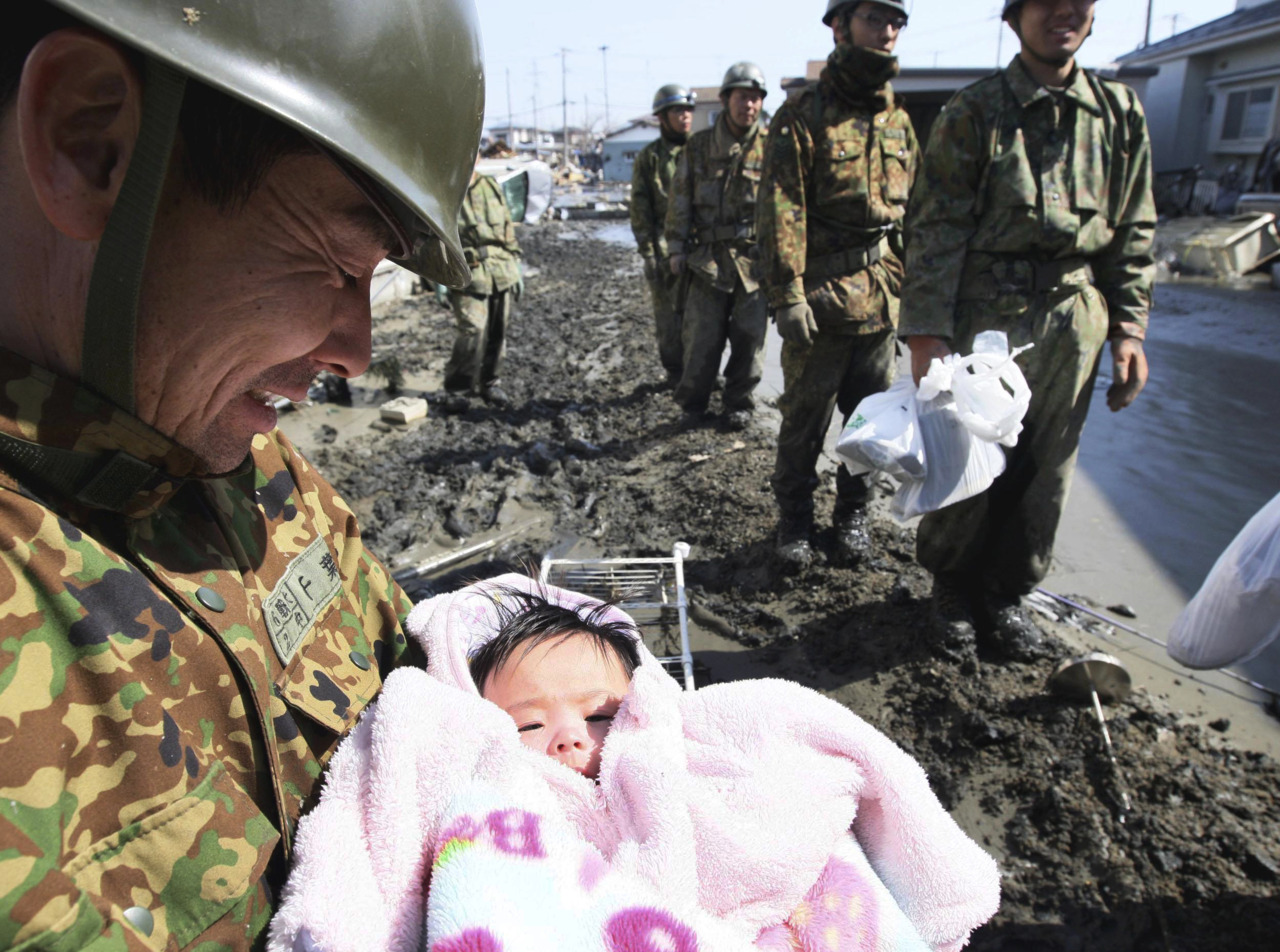
A four-month-old baby girl is rescued in Ishinomaki, northern Japan, three days the initial tsunami


A Japan Self-Defense Force member reacts after rescuing a four-month-old
baby girl in Ishinomaki, northern Japan, Monday, March 14, 2011, three days
after a powerful earthquake-triggered tsunami hit the country’s east coast.
(AP Photo/The Yomiuri Shimbun, Hiroto Sekiguchi)

A beautiful, and much needed moment of joy.

Sabtu, 12 Maret 2011

Incredible swarms of fish form off coast of Acapulco: But was surge caused by tsunami thousands of miles away?

Daily Mail, By DAILY MAIL REPORTER, 12th March 2011

The shores of Acapulco's beaches were this weekend teeming with masses of fish packed so tightly they looked like an oil slick from above.

Thousands of sardines, anchovies, stripped bass and mackerel surged along the coast of the Mexican resort in an event believed to be linked to the devastating Japanese tsunami.

Delighted fishermen rushed out in wooden motor boats, abandoning their rods and nets and simply scooping the fish up with buckets.

A man photographs a shoal of sardines off the shore of Acapulco

Fishermen flocked to the water to take advantage of the surge
Some experts believe the phenomenon is directly related to
the Japanese tsunami

'There were about 20 or 30 fishermen and there were people who came with their kids to take advantage of it,' Carlos Morales said.

The fishermen attributed the strange phenomenon to the unusual currents unleashed by tsunami that followed the earthquake in Japan.

More...

Experts couldn't be sure.

'It would fall into that category where you would love to make the connection, but who knows?' said Rich Briggs, a geologist with the U.S. Geological Survey.

'Tsunamis can change local currents, but it's hard to make a firm connection.'

Fishermen in Acapulco say they have never see such large schools
of fish so close to the coast

The fish were so tightly packed they looked like an oil slick from above

Some bathers steered clear of the mysterious event and kept out of the water


Related Article:

Rabu, 12 Januari 2011

Huge Waves Destroy Homes in East Indonesia

"Like tsunami, the huge walls of waters destroy everything on the coast"

VIVANews, RABU, 12 JANUARI 2011, 10:24 WIB Ismoko Widjaya

VIVAnews - Scores of homes on the coastal area of Sikka Regency, East Nusa Tenggara, were severely damaged by massive waves of more than 3 meters in height last night. More than 500 people are seeking refuge to safer places.

Huge waves thumping coastal area
(VIVAnews/Nurcholis Anhari Lubis)
"I've lost my house. Like tsunami, the huge walls of waters destroy everything on the coast," said Nikodemus Domi, an inhabitant of Kelurahan Waioti, today, Jan 12.

The local administration has deployed an emergency response team to assist and evacuate the affected people.

43 homes are found destroyed and collapsed into the sea. In addition, dozens of fishermen's boats were smashed by the waves.

Extreme weather also caused whirlwind to take place in some other areas in the province.

RELATED NEWS

Rehobot Ship from Oeba harbor was also thumped by the high waves on Tuesday. As many as 15 passengers and ship crews were rescued by local fishermen who happened to be around the scene.

"Most of the passengers jumped into the sea on jerry cans and boards. Fishermen then came to the rescue," said the ship's captain, Yusuf Ton.

Coverage by: Jemris Fointuna | Kupang
Translated by: Bonardo Maulana W

Selasa, 30 November 2010

Half of RI`s mangrove forests heavily damaged : Expert

Antara News, Tuesday, November 30, 2010 19:07 WIB

Bogor (ANTARA News) - Half of Indonesia`s mangrove forests are heavily damaged and facing total destruction due to ecological problems, an expert said here Tuesday.

Bogor Institute of Agriculture (IPB) mangrove expert Professor Cecep Kusmana said most of Indonesia`s mangrove forests were in critical condition because of ecological disturbances.

Cecep hoped the government, the Forestry Ministry in particular, would undertake an emergency response to save the mangrove forests as they were on the brink of complete destruction.

"The threat to our mangrove forests is very concerning and they will vanish if we don?t act now," Cecep said.

The precarious conditions of the country`s mangrove forests needed to be addressed through serious actions by the central government , the Forestry Ministry and all stakeholders, he said.

The governments of regions where the mangroves were located also had an important role to play in saving them as they were the local policy makers.

"Local governments and the Forestry Ministry are expected to work together to stop further damage to mangrove forests," he said.

On the occasion, Professor Cecep also introduced the "Guludan" technique to save mangrove forests, which was considered as the appropriate technology to revitalize heavily damaged and critical forest areas.

The Guludan technique was mainly done by using a bamboo pole that planted deep in the mangrove areas and formed as a square partition with adjustable size.

In the research, the proper square measurement was done by 4 four meters wide, six meters long and two meters deep into the mangrove`s soil.

These Guludan must be filled with bags full of dirt on the bottom and then piled with approximately 50 centimeters high dirt on the top as the plant`s medium.

After the structure is built, mangrove sprouts can now be planted at a certain distance from each other.

Related Article:


These maps show the location and relative density of mangroves, which cover roughly 137,760 square kilometers (53,190 square miles) of Earth’s surface. The forests can be found in 118 different countries and territories, though nearly 75 percent of their area occurs in just 15 countries. They are most often found straddling the equator between 25º North and South latitude. About 42 percent of the world’s mangroves are found in Asia, with 21 percent in Africa, 15 percent in North and Central America, 12 percent in Australia and the islands of Oceania, and 11 percent in South America.

Jumat, 19 November 2010

Indonesia Mentawai Tsunami Was 17 Meters High: Expert

Jakarta Globe, Camelia Pasandaran | November 19, 2010

Jakarta. The tsunami that devastated the Mentawai Islands off West Sumatra last month featured waves much larger than would normally have been expected from the magnitude 7.7 earthquake that spawned it, according to a tsunami expert.

Jose Borrero, from ASR Ltd., a marine consulting firm, said on Friday that the finding was extraordinary.

“We were extremely surprised by the size of the waves on one of the small islands offshore of Pagai,” he said at a press conference at the office of the presidential advisory council.

“We found evidence that the tsunami waves reached a height of 17 meters, which was much bigger than we had expected to find,” he said.

Borrero, who is also a researcher at the University of Southern California’s Tsunami Research Center, said that while most residents of the islands were aware of the potential for a tsunami, the majority had been caught unawares by the relative weakness of the Oct. 25 quake.

“They knew that earthquakes are associated with tsunami, and that they should be aware of evacuating if they felt a strong earthquake,” he said.

“However, this earthquake didn’t feel that strong to them, especially when compared with previous earthquakes in the area. So some people didn’t evacuate immediately upon feeling the earthquake. It wasn’t until they actually heard the sound of the waves coming through the trees and tearing down the forest that they actually knew that they had to go.”

He said that because Indonesia would always be prone to tsunamis, residents should learn to read the signs.

“Basically, tsunamis and earthquakes are part of natural life,” Borrero said.

“You can’t live in fear of them. It’s best to understand them and work with a national system. By understanding them, we have the chance for survival. This isn’t something to be afraid of, but to be aware of, to know what to look for,” he said.

At least 461 deaths have been confirmed as a result of the tsunami, while 43 others remain missing and are feared dead.

The waves also rendered nearly 8,000 people homeless.

Hermann M. Fritz, a tsunami expert from the Georgia Institute of Technology in the United States, said the real measure of an earthquake’s potential for causing a tsunami in tectonic subduction zones such as the Mentawais, was not the perceived strength of the quake but rather its duration.

“How long the quake lasts will indicate its potential for a tsunami,” he said.

“If you feel the shaking for more than 30 seconds or a minute, it’s important to evacuate immediately.”

Danny Hilman, a researcher at the Indonesian Institute of Sciences (LIPI), said the Mentawai quake lasted more than a minute.

However, he said most local people interviewed by the experts had said that at the time of the quake they only felt a swaying motion, and thus did not feel the need to evacuate.

He said that in the case of Mentawai, while the quake registered at a magnitude of 7.7, its long duration meant it was more like a magnitude 8 temblor.
Related Posts Plugin for WordPress, Blogger...