Tampilkan postingan dengan label River. Tampilkan semua postingan

Kamis, 17 Februari 2011

Halong Bay tourists dead as Vietnam boat sinks

BBC News, 17 February 2011

Related Stories

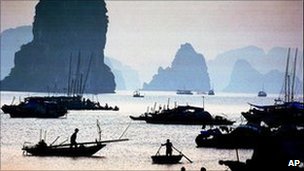
At least 11 tourists and a guide have drowned after a tour boat sank in Halong Bay in northeastern Vietnam.

Halong Bay is a popular tourist area and a
World Heritage Site
The boat was touring in the picturesque Unesco World Heritage Site in Quang Ninh province when it went down.

At least 21 foreign tourists were on the live-aboard boat when it sank before dawn near Titov island.

Vietnamese media quoted a provincial vice-governor as saying the tourists on board were from the US, the UK, France, Russia, Denmark and Sweden.

"So far the rescue team has rescued 15 people, including nine foreign tourists and six crew, and pulled out 12 bodies," Ngo Van Hung, director of the Halong Bay Management Department, told Reuters by telephone.

All of the bodies have been sent to Bai Chay Hospital for identification.

A hospital manager said the survivors were "in panic" but had now returned to their hotels.

Vu Van Thin, a senior official with the Quang Ninh province People's Committee, the local government told reporters that bad weather did not cause the sinking.

"According to our initial information part of the boat suddenly broke," he said.

The boat carried two Vietnamese tourists, one of whom is believed to have died.

Halong Bay, whose name translates as "Descending Dragon Bay", is renowned for its limestone karsts and isles.

Tourists often stay overnight on boats touring the hundreds of islets scattered throughout the scenic bay.

Rabu, 09 Februari 2011

Rotterdam mayor in Jakarta to help

RNW, 8 February 2011, By Michel Maas

(Photo: RNW/Michel Maas)

The Mayor of Rotterdam, Ahmed Aboutaleb, is visiting the Indonesian capital Jakarta. The two cities have signed a cooperation agreement for water management, but can Rotterdam's good intentions overcome the enormous problems facing the Indonesian port?

The mayor and his entourage are watching a small dredger pushing a mountain of thick black sludge and unidentifiable waste in front of it. A bucket scoops sludge from the water. The show is part of a project which doesn't seem to be making much impact. So much rubbish has accumulated under the bridge on which the bucket grab is standing that a dam has been created.

The dredging project is one of those in which Rotterdam is involved. It's not making any headway because there is no budget. Apparently that often doesn't appear until halfway through the year. No one in the mayor's group understands how this can be possible, but it seems that's the way things work here: Jakarta can do nothing without the government, the city services can do nothing without a budget. "The system needs to change" remarks Mayor Aboutaleb, but there is nothing Rotterdam can do to help with that.

Dry feet

The mayor has just signed an agreement under which Rotterdam is committed to work with Jakarta on water management. "Rotterdam can do a lot for Jakarta. We have a great deal of expertise with water." And expertise is much needed in Jakarta.

Mayor Aboutaleb is given a tour of the northern area, where the city meets the sea. The ground is visibly sinking: at the rate of seven centimetres a year. It won't be long before large parts of the city are under water.

He compares the situation with the Netherlands of 1953: after the flood everyone in Rotterdam was persuaded of the need for good seawalls. "Dry feet are a must. I see people in Jakarta are now aware of that. Dry feet are topic number one!"

Brick wall

The dredgers are part of the dry feet initiative. They will be used to clear out Jakarta's choked up canals and ditches in order to solve another water problem. Every rainy season parts of the city are flooded because there is nowhere for the water to go.

There are no seawalls to be seen and the dredgers stop working as soon as the mayor and his entourage are back on the coach. Ahmed Aboutaleb sighs "sometimes I have the feeling I'm up against a brick wall". Two days in Jakarta and the mayor seems close to despair already.

Then there is Jakarta's massive traffic problem. With no public transport and a desperate lack of roads, the city is in danger of coming to a complete standstill. On Sunday the mayor had an opportunity to spend plenty of time in a weekend traffic jam himself.

Religious background

But Aboutaleb is adamant: "Rotterdam can do a lot for Jakarta". Jakarta's governor, Fauzi Bowo, acknowledges that. Rotterdam is giving his officials training courses and Rotterdam is also giving Jakarta a foot in the door in the Netherlands, in Europe if you look at the broader picture. "We can't finance our projects ourselves. But we can talk to the World Bank, the Asian Development Bank and the European Union." He may not expect much of Rotterdam but every bit of help is clearly welcome.

Mayor Aboutaleb has another lesson for the Indonesians. The Netherlands is always described there as "the land of the windmills". Then there's the colonial history. And Geert Wilders. "At dinner they asked me what it was like being mayor of Rotterdam with my name and religious background. But in the Netherlands you can be given opportunities no matter where you were born."

He is opposed to the image of the Netherlands "elsewhere in the world, including here in Indonesia" as a country slipping into a deep pit of racism. "It's absolutely not true. I think it's important for someone like me to tell his story on a regular basis."


Related Article:


Kamis, 08 Juli 2010

Pertamina Says Oil Spill All Mopped Up as Police Probe Negligence Angle

Jakarta Globe, July 09, 2010, Candra Malik,Arientha Primanita& Fidelis E Satriastanti

State oil and gas company Pertamina has succeeded in siphoning almost all of the crude oil that spilled into a river in Blora, Central Java, following a leak at its local fuel depot, an executive said on Thursday.

The leak, which police say might have been caused by negligence on the part of an officer on duty at the depot, on Wednesday sent thousands of liters of crude into the nearby Ledok River, covering it for kilometers in a thick layer of oil.

Fires, the causes of which were not yet known, also broke out on the surface, but the main blazes have already been extinguished, officials say.

Basuki Trikora Putra, Pertamina vice president of corporate communications, confirmed the oil spill and said that the company had carried out the necessary cleanup actions.

“We’ve managed to extract almost 95 percent of the spilled oil using a pump,” Basuki said.

“There were fires [at the site] for a while but we’ve managed to douse most of them.

“We’ll conduct an audit to see whether there are any external and internal causes for the accident, besides technical issues,” he said, adding the company had not yet calculated its losses.

On Thursday, some areas of the river still spewed thick smoke, a local policeman said, but the smoke did not prevent several residents from nearby settlements from trying to scoop the oil from the surface for use at home.

Some residents told reporters there that they planned to use the oil as fuel for cooking.

Blora Police Chief Adj. Comr. Isnaini Ujiarto told the Jakarta Globe that police were helping Pertamina officials from the depot to “localize this incident.”

“Fortunately, the depot is in the middle of a teak forest, far from any settlement, so to date there have been no reports of casualties,” Isnaini said.

Pertamina has contained the spill on the surface of the river and used oil pumps to siphon the crude into tankers, he said.

He added that an inspection of the storage facilities in the depot showed that although the fuel tanks were old and rusted, dating back to the Dutch colonial era, there was no sign of a leak.

Police, he said, suspect negligence on the part of an employee at the depot, who might have forgotten to close down a valve on time, causing the crude oil to flow into the river.

Police are questioning workers at the depot but have yet to name a suspect, he said.

As a precaution, police have closed access to the river from the three villages closest to the location of the spill — Ledok, Gagahan and Pojok Watu — to prevent people from scooping up the fuel, Isnaini said.

Berry Nahdian Furqon, executive director of the Indonesian Forum for the Environment (Walhi), urged the directors of Pertamina to evaluate their management and technology, pointing out that similar accidents had hit the company in the past.

“This is not the first time that there’s been a leak, so there should be a thorough investigation of the officials, and the directors of Pertamina should take full responsibility,” Berry said, adding that the incident showed how safety issues in the oil and gas industry were often ignored.

Pertamina should also be responsible for all costs stemming from the incident, including cleaning up the river, repairing other environmental damage and compensating villagers affected by the oil spill, he said.

Under the 2009 Environmental Protection and Management Law, heavy penalties can be imposed on corporations or institutions found to have caused environmental pollution.

Imam Hendargo, a senior official at the State Ministry for the Environment, said a team from the district environmental office had been dispatched to the site to investigate the leak and assess the damage.


Related Article:
Kamis, 17 Juni 2010

Nestle to Sail Amazon Rivers to Reach Emerging-Market Consumers

Businessweek, June 17, 2010, 1:13 AM EDT

June 17 (Bloomberg) -- Nestle SA will begin sailing a supermarket barge down two Amazon river tributaries tomorrow as it competes with Unilever to reach emerging-market customers cut off from branded goods.

The world’s largest food company will send a boat with 100-square meters (1,076 square feet) of supermarket space on a journey to 18 small cities and 800,000 potential consumers on the Para and Xingu rivers in Brazil, before starting the journey again. The vessel will carry 300 different goods including chocolate, yogurt, ice cream and juices.

“Direct distribution gives them a competitive edge over regional competitors who don’t have the resources to do this kind of thing,” said James Targett, an analyst at Consumer Equity Research in London. He has a “positive” rating on Vevey, Switzerland-based Nestle.

Nestle expects as many as 1 billion people in emerging markets to exit poverty and be able to afford its products in the coming decade. The foodmaker has adapted its products in such regions by offering smaller, cheaper versions of products such as Alpino ice cream and Ninho milk powder through direct distribution to make them more accessible to low-income shoppers. Unilever has also been building a distribution network into Brazil’s shantytowns.

Strong in Brazil

“Unilever is very strong in Brazil and has been there a long time, and is used to getting poorer consumers in rural areas,” said James Amoroso, a food industry consultant based in Walchwil, Switzerland. “It’s obviously more expensive to establish yourself before the retail distribution is there, and this is what Nestle is trying to do.”

Supermarket purchases in Brazil’s impoverished northern and northeast regions have outpaced growth from richer states in the south and southeast for the last two years as social programs and a higher minimum wage increased disposable income for the poor, Sussumu Honda, head of the national supermarkets association, said in an interview June 2.

Brazil’s supermarket sales rose a record 15 percent in March from a year earlier, according to data from the country’s statistics agency. The increased demand means that supermarkets in remote areas have had difficulty keeping products on the shelves as suppliers are unable to meet orders, Honda said.

Economic Growth

Latin America’s biggest economy expanded 9 percent in the first quarter, the fastest annual growth rate since 1995, led by domestic demand and investments, the statistics agency said last week. Policy makers raised the benchmark interest rate for the second time this year to 10.25 percent last week to keep the economy from overheating.

Nestle sells 3,950 products in “popularly positioned” formats designed for low-income consumers. Smaller packs allow poor consumers to afford branded goods like richer shoppers rather than turn to generic alternatives. The company often adds nutrients such as iron, zinc, iodine and vitamin A to address deficiencies among the poor.

The Swiss company has a team of 7,000 saleswomen who peddle packs of Nestle goods door-to-door in Brazilian slums. In Indonesia, Nestle cut out middlemen and began shipping directly to wholesalers to expand its reach to consumers among the country’s 17,000 islands.

Nestle has forecast global sales from such products eventually reaching 20 billion Swiss francs ($18 billion) from 8.8 billion francs last year. Unilever, which sells smaller sizes of its products, such as Seda shampoo, in Brazil, already gets half its sales from developing countries.

Emerging Markets

Nestle had 2009 food and beverage sales growth in emerging markets of 8.5 percent, more than double the rate of its total business. The company has said it aims to boost the proportion of sales from developing countries to 45 percent in a decade from 35 percent now.

Nestle isn’t the only one to take to water transport in the Amazon. Banco Bradesco SA, Brazil’s second-biggest bank by market value, started to offer banking services in December via the Solimoes River, also in the Amazon. Bradesco made 700 new clients after six months, Director Odair Afonso Rebelato said.

“These clients don’t want to be labeled as poor,” Rebelato said. “They want the same products as everybody else.”

--Editors: Chris Staiti, Paul Jarvis

To contact the reporters on this story: Tom Mulier in Geneva at tmulier@bloomberg.net; Iuri Dantas in Brasilia at idantas@bloomberg.net

To contact the editor responsible for this story: Celeste Perri at cperri@bloomberg.net.

Minggu, 16 Mei 2010

Boat capsizes, killing three

Antara News, Sunday, May 16, 2010 22:47 WIB

Cilacap, C Java, (ANTARA News) - A boat carrying 34 domestic tourists capsized in Citanduy river serving as the border between Central Java and West Java on Sunday, killing three people.

Suharyanto, head of Patimuan subdistrict, Cilacap district, Central Java, confirmed the accident saying 24 people survived the accident and seven others were missing.

"We received the news at around 08.30 a.m. We are searching for the seven missing passengers now," he said.

The boat capsized after being hit by a large wave at the river`s estuary on its way back from Masigid Sela cave at Ujunggalang village in Cilacap district, Central Java, to Kalipucang pier in Ciamis district, West Java.

The three dead victims were identified as Ratinah (45), Warti (50), and Kasminah (50).

Related Posts Plugin for WordPress, Blogger...