Sabtu, 06 November 2010

Scientists find 'dramatic' damage to marine life near BP spill site

CNN News, From Nick Valencia, November 6, 2010

Scientists have found evidence of "dramatic" damage to deep-sea coral near the site of the Gulf oil disaster. On a November 2 expedition, a research team encountered an apparently "unhealthy" colony of madrepora -- a hard coral species -- at a depth of 1,400 meters (about 4,600 feet)

STORY HIGHLIGHTS
  • Biologist cites "compelling circumstantial evidence"
  • The coral is covered in "brown material," he says
  • The research expedition was government-funded

(CNN) -- Scientists have found evidence of "dramatic" damage to deep-sea coral near the site of the Gulf oil disaster, with one biologist describing it as a shocking find that "slapped you in the face."

"This was the first time that anyone has seen a visually compelling indication of impact to deep sea animals in the vicinity of this deep-sea event," said Charles Fisher, a Penn State University biologist and the leader of a government-funded research expedition.

"We have some very compelling circumstantial evidence and that came from this expedition where we were out studying deep sea coral communities we know about, and exploring for new communities."

The research team encountered an apparently "unhealthy" colony of Madrepora -- a hard coral species -- on November 2 at a depth of 1,400 meters. While some in the coral colony appeared normal, others were covered in a "brown material" and were producing "abundant mucous," he said.

The scientists also encountered a community of soft corals nearby that also appeared to be affected. Extensive portions of the coral colonies were either recently dead or dying.

The discovery was made more than six months after an explosion aboard an oil rig sent crude spewing from a BP-owned well deep below the Gulf of Mexico. Researchers found the coral about seven miles southwest of the site of the spill.

Fisher, who called the discovery a "smoking gun," said researchers can't say for certain that the coral died from the oil, noting that dispersants could have been the culprit.

"The next step is to go back out there and look for direct evidence that the oil caused this damage. We're looking for hydrocarbons that could have been fingerprinted," Fisher said.

BP officials could not immediately be reached for comment Saturday.

Ian MacDonald, a professor of oceanography at Florida State University, said the damage is significant because "this is the first indication of just how widespread the damage is."

He wondered whether there is damage that has not yet been discovered.

Related Articles:


Jumat, 05 November 2010

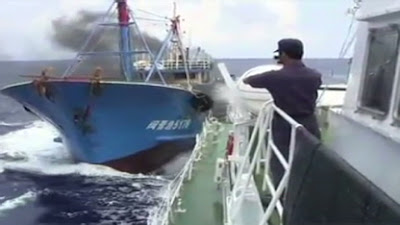
Lawmaker: Leaked video shows crash that led to China-Japan dispute

CNN News, From Kyung Lah, November 5, 2010

Japan, China ship collision fuel tensions

STORY HIGHLIGHTS
  • The YouTube video is authentic and not doctored, a Japanese legislator says
  • He calls the leak "a big mistake for the government"
  • China has made an "official inquiry" with the Japanese prime minister's office
  • Kan's office is investigating the leaking of the video

Tokyo, Japan (CNN) -- A leaked video is circulating in cyberspace, showing a boat collision that sparked a recent diplomatic battle between China and Japan.

The YouTube video shows the same collision that Japanese lawmakers watched on video last week, said legislator Hiroshi Kawauchi, of the ruling Democratic Party of Japan.

The Japanese Coast Guard shot the video, which is authentic and not doctored, said Kawauchi, who is a member of the House of Representatives in the Diet, Japan's legislature.

"The fact that the video was leaked is a big mistake for the government," he added. "It is totally different from presenting it to the public in an official manner, and it leads the people's further erosion of faith in Japan's government."

In September, Japan detained the crew of a Chinese fishing boat off disputed islands in the East China Sea. China calls the islands the Diaoyu; Japan calls them the Senkaku.

In response to the detainments, China made increasingly aggressive diplomatic threats. Beijing also halted ministerial-level talks with Tokyo, and both sides canceled trips to each other's nations.

Japan has since released the fishing crew, who China says were stopped illegally. Japan initially accused the captain of obstructing Japanese public officers while they performed duties. But authorities later said that releasing him was in the interest of maintaining relations with China.

The crash video that Japanese lawmakers saw has not been released to the public.

The video, posted on YouTube, shows what is thought to be the Chinese fishing trawler ramming into a ship, thought to be a Japanese Coast Guard vessel.

The Chinese government dismissed the video after Japanese lawmakers saw it, saying it had been edited and that it did not change the ownership of the islands.

On Friday, China's Assistant Minister of Foreign Affairs Cui Tiankai said: "I think the China-Japanese relationship has to overcome the current difficulties and move forward. This will serve the fundamental interests of both countries. So [we] hope [the] Japanese side will do everything possible to make sure that there's no further disruptions of the relationship."

The Chinese Embassy in Tokyo has contacted the office of Japanese Prime Minister Naoto Kan about the leaked video, making an "official inquiry," Kan's office said. No official protest was lodged.

Kan's office is investigating the leaking of the video, which has been shown on Japanese television.

The man apparently doing the videotaping says on the video that the date is September 7, 2010. That matches the detaining of the fishing crew.

The man also says on the video, in Japanese: "We've ordered them to stop, in Chinese language, but they didn't stop."

As the Chinese boat approaches, shouting is heard in Japanese. Unidentified voices shout: "Back off! Back off!"

CNN's Jo Ling Kent contributed to this report.


Related Articles:

Selasa, 02 November 2010

Ecotourism project in Thousand Islands takes flight

The Jakarta Post, Maria L. Kegel, Contributor, East Kotok, Thousand Islands | Tue, 11/02/2010

Dockside: Visiting vet nurse Mirjam Bos from the
Netherlands relaxes on the pier at East Kotok Island
after snorkeling the nearby reef, which extends 40 meters
from shore to the drop-off area. Jakarta Animal Aid
Network (JAAN) team members hope visitors to the eco-
bungalows will take advantage of the other activities
that help reconnect urban dwellers with nature, such as
learning about the raptors at the sanctuary and diving.
Repairing reefs with rubble, making furniture out of driftwood and using glass bottles for walls: Femke den Haas and Vera Clapham are good to the environment and they are hoping their brand of ecotourism in Pulau Seribu (Thousand Islands) will encourage others to follow their lead.

The two women, heading the Jakarta Animal Aid Network (JAAN) ecotourism team, aim to set a good example with their environment friendly bungalows on East Kotok Island, which they hope will generate enough revenue to keep the operation going and fund JAAN’s raptor rehabilitation program.

In return, visitors coming to the island retreat get a chance to reconnect with nature and see a difference being made to the wildlife and ecology of the area, they said.

A raptor sanctuary is set up near the rehabilitation operation on site, providing opportunities to learn about the endangered White Bellied Sea Eagles and Brahminy Kites (Elang Bondol, Jakarta’s national symbol). There is also a coral reef that extends 40 meters from shore to the drop-off area, and several dive sites around the area.

“It’s not just about hanging around on the beach because people can do that anywhere. This is more of an opportunity for people who love to be in nature, and want to learn about nature in the Thousand Islands,” den Haas said.

The team’s plans include renovating the abandoned bungalows of a former dive resort into open-air huts, making furnishings for the dwellings out of the island’s driftwood and becoming energy self-sufficient.

“We don’t want to use air-conditioning when there are sea breezes and why not look into alternative energy options with all the sun here,” den Haas said, adding that the team was saving up for solar panels by setting aside a portion of funds raised from other projects.

A rainwater catchment system providing water for toilets would also be incorporated in the roofing of the renovated bungalows, and there were plans to take the existing organic garden to a higher level, den Haas explained.

Some of the material the team needs for their project, which started in early October, is close at hand.

“The concrete blocks will be reused to make other parts [of the hut] and glass bottles will be used in the walls for letting in light, while adapting it all to a tropical environment,” Clapham said.

Lighting fixtures, furniture, mirrors, picture frames, lampshades, doors, flooring and even tissue boxes will be made from the island’s abundance of raw material, mainly the uniquely formed driftwood, which inspires Clapham to create the furnishings simply by studying its shape and texture.

“It’s about using what you have out here for furniture. Although they were already doing that, we’re bringing the design work and recycling to a new level,” Clapham said, adding that they wanted to use only sustainable materials to create an aesthetic environment.

Drifting away: JAAN ecotourism volunteer Vera
Clapham thinks of the possibilities for an interesting
piece of driftwood found on the beach on East
Kotok Island. Clapham helped make furnishings
from raw material found locally for another
ecotourism project last year on Macan Island.
Nothing on the island will be wasted. The concrete rubble being cleared from the existing bungalows will form artificial reef structures to help coral grow and recover in reef-damaged areas hit by boat anchors.

“Unlike bio-rocks, these [artificial reefs] won’t use electricity, but we’ll construct holes in the center so fish can pass through them and the corals can easily grow on it,” den Haas said, adding that the team had also transplanted some corals, making the addition of these structures a welcome combination.

The team has since put up moorings for dive boats to use and to stop future reef damage.

The bungalows had been part of Coconut Island Resorts, a dive resort which shut down in 2006. Den Haas and the JAAN team, who have been running the raptor rehabilitation program there since 2004 on land lent to them by one of East Kotok’s owners, a nature enthusiast who admires their work, were then allowed to fully manage the entire eastern part of the island.

For the JAAN team, it’s all about getting back to basics, so city comforts, such as air conditioning, are shunned.

But the team is confident that this style of island vacation will catch on with visitors to the area.
“Once people experience relaxing in an open hut, they’ll see the pleasure of it,” Clapham remarked.

Although she is based in Australia, Clapham volunteered for the ecotourism project after meeting den Haas, a co-founder of JAAN, when she offered to walk dogs at the organization’s office in Kemang during a recent visit to see family in Jakarta.

Den Haas, who first brainstormed the idea of running an environment friendly resort, said, “I didn’t know how to fix the bungalows and how to afford it all, and then bang! Vera came along and everything clicked.”

Clapham had spent the previous year on Pulau Macan, also in the Thousand Islands, volunteering to design the furnishings there from the island’s resources for a nine bungalow eco-resort.

“Ecotourism on Macan Island and with what the JAAN team is doing, is an inspiring story, and in these times people need to be aware of positive things happening and not to focus on the doom and gloom. These groups are creating an example to show people we can live differently and harmoniously in a beautiful environment that we can have for a longer time because it’s sustainable.”

— Photos by Maria L. Kegel
Related Posts Plugin for WordPress, Blogger...