Minggu, 07 November 2010

Study: Tuna black market worth billions of dollars


WASHINGTON — The craze for sushi has fueled a black market in tuna worth billions of dollars, as governments collaborate with the industry despite fears for the species' survival, an investigation found.

Global fears over tuna stocks emerged in 2007 when France
 declared it had caught nearly 10,000 tons, double its quota
A seven-month probe by the International Consortium of Investigative Journalists found that fishermen have willfully violated official quotas in order to supply the lucrative tuna market, which is dominated by Japan.

The investigation covered 10 nations but found particular violations in France, where it said the Ministry of Agriculture and Fisheries has joined forces with the tuna industry to doctor catch numbers.

"Everyone cheated," said Roger Del Ponte, one of the six French fishing captains facing criminal charges.

"It's like driving down the road. If I know there are no police, I'm going to speed," he said in the report.

The journalists said the black market in Eastern Atlantic bluefin tuna was worth at least four billion dollars between 1998 and 2007. The calculation came from comparing the estimated total catch of tuna with official quotas and then using rates at Tokyo's Tsukiji fish market.

Global fears over tuna stocks emerged in 2007 when France declared it had caught nearly 10,000 tons, almost double its quota allowed under the International Commission for the Conservation of the Atlantic Tunas (ICCAT), a regulatory body.

"We found that the system failed at every point. It failed in that vessels were overfishing and that officials were turning a blind eye to that overfishing for years," said Kate Willson, a reporter on the investigation.

Facing an outcry, ICCAT came up with a new system in 2008 to keep track of the trade. But the study said the database was ineffectual and the tuna industry was heading to areas with even less oversight such as North Africa.

Willson said the French ministry declined repeated requests for comment.

"There is no way to know if the situation is getting better. We're supposed to trust them that they are getting better," she said.

ICCAT figures found that spawning stock of Eastern Atlantic bluefin tuna has tumbled by nearly 75 percent in the past four decades, with more than half of the loss between 1997 and 2007.

Jean-Marc Fromentin, a marine biologist on ICCAT's scientific body, said that experts had recommended a cut in fishing quotas as long ago as the late 1990s.

"If the countries had listened, then there would have been no risk of collapse," he said in the report.

"But because they didn't pay attention, and they didn't control (catch limits), then after a few years the situation became really critical and we began to speak about the risk of collapse," he said.

ICCAT meets in Paris from November 17 to 27, ahead of which European Union fisheries commissioner Maria Damanaki has called for a substantial reduction in the bloc's tuna catch quota of 13,500 tons.

France has opposed the quota, arguing that tuna stocks will be sustainable by 2022. Diplomats say that France is backed by other Mediterranean countries including Greece, Italy and Spain, while Britain is the only country clearly to back Damanaki's position.

A March meeting in Qatar soundly defeated a proposal backed by the United States and European Union to ban the international trade of Atlantic bluefin tuna after an aggressive lobbying effort by Japan.

The study said that Japan has driven the demand for the Atlantic bluefin, with the industry taking off in the 1980s when the Japanese developed a passion for "toro," the fatty belly of tuna.

But after years of financial backing for the industry, Japan has tried to distance itself from perceived excesses, the study said. Last year it temporarily halted imports from Tunisia due to a lack of required documentation on the catch.

Sabtu, 06 November 2010

Scientists find 'dramatic' damage to marine life near BP spill site

CNN News, From Nick Valencia, November 6, 2010

Scientists have found evidence of "dramatic" damage to deep-sea coral near the site of the Gulf oil disaster. On a November 2 expedition, a research team encountered an apparently "unhealthy" colony of madrepora -- a hard coral species -- at a depth of 1,400 meters (about 4,600 feet)

STORY HIGHLIGHTS
  • Biologist cites "compelling circumstantial evidence"
  • The coral is covered in "brown material," he says
  • The research expedition was government-funded

(CNN) -- Scientists have found evidence of "dramatic" damage to deep-sea coral near the site of the Gulf oil disaster, with one biologist describing it as a shocking find that "slapped you in the face."

"This was the first time that anyone has seen a visually compelling indication of impact to deep sea animals in the vicinity of this deep-sea event," said Charles Fisher, a Penn State University biologist and the leader of a government-funded research expedition.

"We have some very compelling circumstantial evidence and that came from this expedition where we were out studying deep sea coral communities we know about, and exploring for new communities."

The research team encountered an apparently "unhealthy" colony of Madrepora -- a hard coral species -- on November 2 at a depth of 1,400 meters. While some in the coral colony appeared normal, others were covered in a "brown material" and were producing "abundant mucous," he said.

The scientists also encountered a community of soft corals nearby that also appeared to be affected. Extensive portions of the coral colonies were either recently dead or dying.

The discovery was made more than six months after an explosion aboard an oil rig sent crude spewing from a BP-owned well deep below the Gulf of Mexico. Researchers found the coral about seven miles southwest of the site of the spill.

Fisher, who called the discovery a "smoking gun," said researchers can't say for certain that the coral died from the oil, noting that dispersants could have been the culprit.

"The next step is to go back out there and look for direct evidence that the oil caused this damage. We're looking for hydrocarbons that could have been fingerprinted," Fisher said.

BP officials could not immediately be reached for comment Saturday.

Ian MacDonald, a professor of oceanography at Florida State University, said the damage is significant because "this is the first indication of just how widespread the damage is."

He wondered whether there is damage that has not yet been discovered.

Related Articles:


Jumat, 05 November 2010

Lawmaker: Leaked video shows crash that led to China-Japan dispute

CNN News, From Kyung Lah, November 5, 2010

Japan, China ship collision fuel tensions

STORY HIGHLIGHTS
  • The YouTube video is authentic and not doctored, a Japanese legislator says
  • He calls the leak "a big mistake for the government"
  • China has made an "official inquiry" with the Japanese prime minister's office
  • Kan's office is investigating the leaking of the video

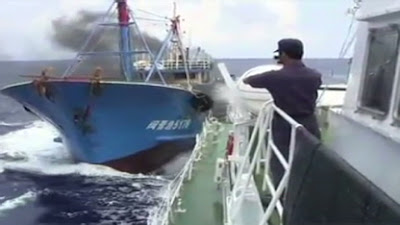
Tokyo, Japan (CNN) -- A leaked video is circulating in cyberspace, showing a boat collision that sparked a recent diplomatic battle between China and Japan.

The YouTube video shows the same collision that Japanese lawmakers watched on video last week, said legislator Hiroshi Kawauchi, of the ruling Democratic Party of Japan.

The Japanese Coast Guard shot the video, which is authentic and not doctored, said Kawauchi, who is a member of the House of Representatives in the Diet, Japan's legislature.

"The fact that the video was leaked is a big mistake for the government," he added. "It is totally different from presenting it to the public in an official manner, and it leads the people's further erosion of faith in Japan's government."

In September, Japan detained the crew of a Chinese fishing boat off disputed islands in the East China Sea. China calls the islands the Diaoyu; Japan calls them the Senkaku.

In response to the detainments, China made increasingly aggressive diplomatic threats. Beijing also halted ministerial-level talks with Tokyo, and both sides canceled trips to each other's nations.

Japan has since released the fishing crew, who China says were stopped illegally. Japan initially accused the captain of obstructing Japanese public officers while they performed duties. But authorities later said that releasing him was in the interest of maintaining relations with China.

The crash video that Japanese lawmakers saw has not been released to the public.

The video, posted on YouTube, shows what is thought to be the Chinese fishing trawler ramming into a ship, thought to be a Japanese Coast Guard vessel.

The Chinese government dismissed the video after Japanese lawmakers saw it, saying it had been edited and that it did not change the ownership of the islands.

On Friday, China's Assistant Minister of Foreign Affairs Cui Tiankai said: "I think the China-Japanese relationship has to overcome the current difficulties and move forward. This will serve the fundamental interests of both countries. So [we] hope [the] Japanese side will do everything possible to make sure that there's no further disruptions of the relationship."

The Chinese Embassy in Tokyo has contacted the office of Japanese Prime Minister Naoto Kan about the leaked video, making an "official inquiry," Kan's office said. No official protest was lodged.

Kan's office is investigating the leaking of the video, which has been shown on Japanese television.

The man apparently doing the videotaping says on the video that the date is September 7, 2010. That matches the detaining of the fishing crew.

The man also says on the video, in Japanese: "We've ordered them to stop, in Chinese language, but they didn't stop."

As the Chinese boat approaches, shouting is heard in Japanese. Unidentified voices shout: "Back off! Back off!"

CNN's Jo Ling Kent contributed to this report.


Related Articles:
Related Posts Plugin for WordPress, Blogger...